
Every sp_configure setting on an instance tells a small story: a value someone changed deliberately, a value nobody’s touched since install, or a value that’s been changed but is still waiting for a restart to actually take effect. Without a full snapshot, most of that story is invisible, and configuration drift between servers that are supposed to be identical goes unnoticed until it causes a problem that’s hard to explain.
This script captures every sp_configure setting in a single result set, with a flag for anything that’s been changed but hasn’t taken effect yet, useful as a baseline, a change-tracking snapshot, or a config-drift comparison between servers.
Why Instance Configuration Snapshot Matters
Configuration settings quietly shape everything from query performance to security surface area, and most of them are set once (or never) and forgotten:
- Baselines this snapshot against a future run to catch unauthorised or accidental configuration changes
- Surfaces settings that have been changed but not yet applied, since some
sp_configurechanges require a service restart - Enables comparing configuration across servers that are supposed to be identical, a common source of “it works on the other server” bugs
- One query captures everything, rather than checking dozens of individual settings by hand
When to Run This Script
- Routine SQL Server health checks
- Before and after any configuration change, to document what actually changed
- Building a baseline for a new server, or before a migration
- Comparing configuration drift between servers in a cluster, AG, or environment tier
The Script
Run the following script against your SQL Server instance.
/*
Script Name : Get-InstanceConfigurationSnapshot
Category    : configuration-and-environment
Purpose     : Capture all sp_configure settings for baseline review and change tracking.
Author      : Peter Whyte (https://sqldba.blog/dba-scripts-get-instance-configuration-snapshot/)
Requires    : VIEW SERVER STATE
HealthCheck : Yes
*/
-- SAFE:ReadOnly
-- IMPACT:Low
SET NOCOUNT ON;

SELECT
    name,
    value         AS configured_value,
    value_in_use  AS running_value,
    minimum,
    maximum,
    description,
    CASE WHEN value <> value_in_use THEN 1 ELSE 0 END AS pending_restart
FROM sys.configurations
ORDER BY name;
The script queries sys.configurations and returns every setting, its configured and running value, valid range, description, and whether it’s pending a restart to take effect.
How To Run From The Repo
Clone DBA Tools, initialize and run the script:
# Clone dba-tools repo:
git clone https://github.com/peterwhyte-lgtm/dba-tools

# Initialize environment:
cd dba-tools
.\Initialize-Environment.ps1

# Capture a full sp_configure snapshot:
.\run.ps1 Get-InstanceConfigurationSnapshot

# To run against a remote sql server:
.\run.ps1 Get-InstanceConfigurationSnapshot -ServerInstance SQLSERVER01
This script lives in the repo at:
sql/monitoring/instance/Get-InstanceConfigurationSnapshot.sqlpowershell/wrappers/monitoring/instance/Get-InstanceConfigurationSnapshot.ps1
Example Output
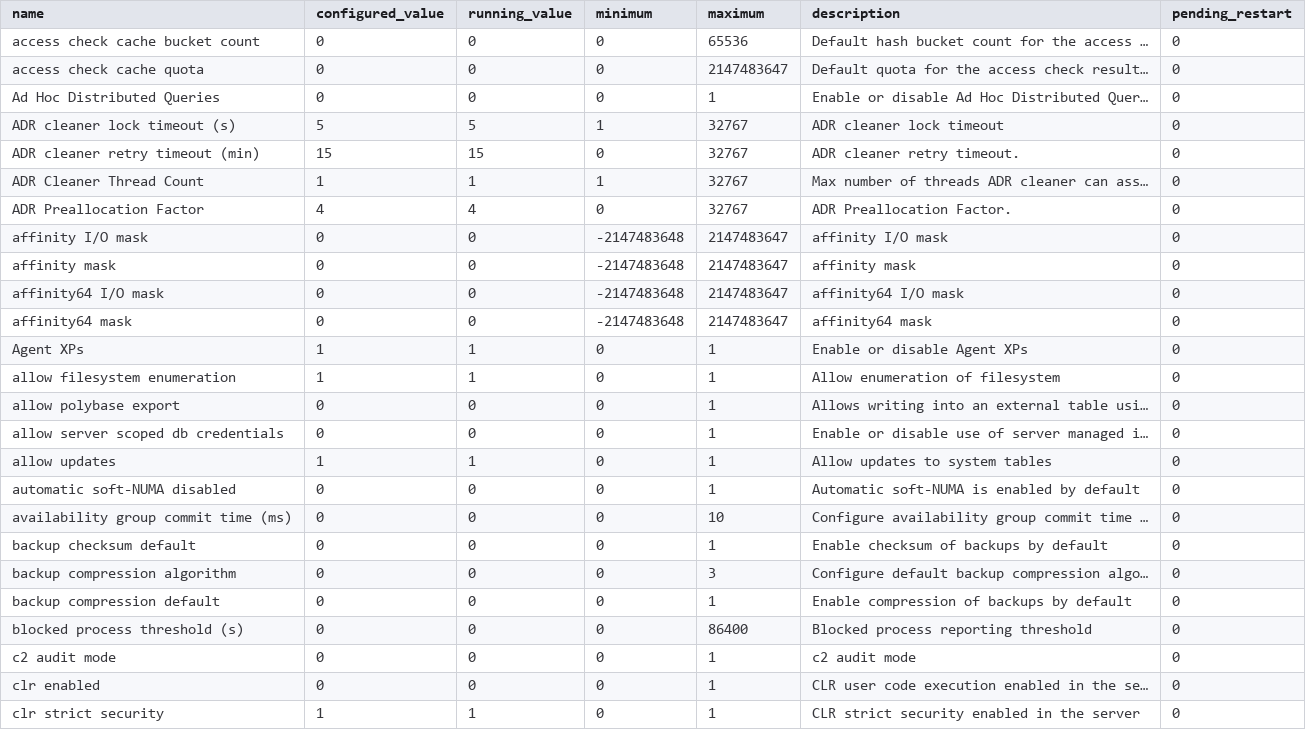
The full result set returns every sp_configure setting, over 100 rows on a default installation. A handful of the more operationally relevant ones from this run:
min server memory (MB) is a genuine example of pending_restart = 1 here: configured to 0, but still running at 16, its previous value, until the next service restart.
Understanding the Results
- configured_value vs running_value, most settings apply immediately (
RECONFIGURE), but some, particularly memory and CPU-related ones, require a service restart. When these two columns differ, that’spending_restart = 1. - pending_restart, a change was made but hasn’t taken effect. Worth checking before assuming a configuration change is live, especially after a change someone else made.
- minimum / maximum, the valid range for the setting. Useful context when deciding a new value.
- Most rows on a default installation are untouched defaults; the interesting ones are the handful someone has deliberately changed.
Best Practices
- Take a snapshot before and after any configuration change, so there’s a record of exactly what changed and when.
- Keep a baseline snapshot for servers that are supposed to be configured identically (AG replicas, load-balanced tiers), and diff future snapshots against it.
- Don’t assume a configuration change is live just because you ran
RECONFIGURE. Checkpending_restartfor settings that need a service restart.
Microsoft’s reference covers sp_configure and sys.configurations in full.
Related Scripts
You may also find these scripts useful:
- Server Inventory (hub)
- Check When SQL Server Was Last Restarted
- Instance Configuration Score
- MAXDOP Configuration
- Memory Configuration and Usage
- OS Configuration Checks
- Resource Governor Config
- SQL Server CPU Topology and Scheduler Details
- Trace Flags
- DBA Scripts: The Complete Guide, the map across every script on this site
Frequently Asked Questions
Why does a setting show a different configured and running value?
Because that setting requires a service restart to take effect. RECONFIGURE applies most changes immediately, but memory and CPU-related settings often need a restart before running_value catches up to configured_value.
How is this different from Get Instance Configuration Score?
This script is the raw snapshot, every setting, unfiltered. Instance Configuration Score (a separate post) is a graded audit that scores a subset of settings against best-practice recommendations. Use this one for a full baseline or drift comparison; use the score for a quick pass/fail read.
Summary
A full configuration snapshot is one of the simplest things to capture and one of the most useful things to have on hand when something doesn’t match expectations, whether that’s a query behaving differently on one server than another, or a setting someone swears they never changed.
Run this script as a baseline on every server, and again after any configuration change, so there’s always a record of exactly what the instance looked like at that point in time.
Leave a Reply