
From Finding Orphaned Users to Actually Fixing Them
Get Orphaned Users answers “do I have this problem”. This script answers the next question: “what do I actually run to fix it”. After a database restore onto a server where the matching logins weren’t created with the same SID, database users can end up orphaned, their SID no longer matches any login on the instance, so authentication fails even though the user object still exists in the database.
Fix-OrphanedUsers scans every online user database, read-only ones included, finds every orphaned user, and generates the ALTER USER ... WITH LOGIN statement to remap each one, wherever a login of the same name actually exists to map it to. Where one doesn’t, it says so explicitly instead of generating a statement that would fail.
Why Orphaned Users Matters
- Orphaned users fail silently until someone tries to log in. The database looks fine; nothing errors until an application or person actually authenticates as that user and gets denied.
- It’s a near-guaranteed side effect of certain migration patterns. Restoring a database onto a new server without preserving login SIDs (via
Generate-LoginScript.sql WITH SID = ...) orphans every SQL-authenticated user in it. - The fix is mechanical but risky to get wrong at scale. Hand-mapping users one by one across dozens of databases is slow and error-prone; generating the DDL and reviewing it before running is faster and safer.
- Not every orphan can be auto-fixed, and the script is explicit about which ones it can’t, rather than guessing.
When to Run This Script
- On the TARGET server, immediately after restoring databases during a migration, once the matching logins have been created
- After any restore where you’re not certain the source and target logins share the same SIDs
- As a periodic check on a server that regularly receives restored databases (refresh-from-prod environments are a common repeat offender)
- Following up a Get Orphaned Users finding, to generate the actual fix rather than fixing users by hand
The Script
Run the following script against your SQL Server instance.
/*
Script Name : Fix-OrphanedUsers
Category    : migration
Purpose     : Generate ALTER USER statements to re-map orphaned database users to their
              matching server-level logins across all user databases. Run on TARGET after
              databases are restored and logins are created.
Author      : Peter Whyte (https://sqldba.blog/dba-scripts-fix-orphaned-users/)
Requires    : VIEW ANY DATABASE, VIEW SERVER STATE, plus access to each online database it inspects
*/
-- SAFE:ReadOnly
-- IMPACT:Low
SET NOCOUNT ON;

/*
  DESIGN: After restoring databases from a source server, SQL logins are re-created with the
  same SID (via Generate-LoginScript.sql WITH SID = ...). This means SQL-authenticated users
  are NOT orphaned — their SID in sys.database_principals matches the new login's SID.

  Windows-authenticated users are also fine because the AD SID never changes.

  The orphan case that CAN occur:
    - SQL logins created without SID preservation (e.g. the old login was dropped and re-created
      and the SID therefore differs from what is stored in the restored database).
    - Databases restored from an environment where logins no longer exist on the new server.

  This script generates ALTER USER ... WITH LOGIN statements for any user in any database whose
  SID does not match any login on this instance. It assumes login name = user name (common case).
  Review the output before executing — not every orphan can be fixed with a simple name match.

  This script never applies a fix. It RETURNS the ALTER USER statements as text for you to
  review and run yourself, which is why it is classed ReadOnly. There are no commented-out
  EXEC lines to uncomment: the one EXEC sp_executesql below collects the orphan list, it does
  not repair anything.
*/

DECLARE @ddl  nvarchar(max) = N'';
DECLARE @crlf nchar(2)      = CHAR(13) + CHAR(10);
DECLARE @sql  nvarchar(max);
DECLARE @dbname nvarchar(128);

SET @ddl = @ddl
    + N'-- ================================================================' + @crlf
    + N'-- Orphaned User Fix Script' + @crlf
    + N'-- Target  : ' + @@SERVERNAME + @crlf
    + N'-- Generated: ' + CONVERT(nvarchar(30), GETDATE(), 120) + @crlf
    + N'-- Review before executing. Each line maps a database user to a login' + @crlf
    + N'-- by name - verify the name match is correct first.' + @crlf
    + N'-- ================================================================' + @crlf + @crlf;

-- Temp table to collect orphans across all databases
IF OBJECT_ID('tempdb..#orphans') IS NOT NULL DROP TABLE #orphans;
CREATE TABLE #orphans (
    database_name nvarchar(128),
    user_name     nvarchar(128),
    user_type     char(1),
    user_sid      varbinary(85),
    is_read_only  bit
);

IF OBJECT_ID('tempdb..#failed') IS NOT NULL DROP TABLE #failed;
CREATE TABLE #failed (
    database_name nvarchar(128),
    reason        nvarchar(2048)
);

-- READ-ONLY DATABASES ARE SCANNED, NOT SKIPPED. This filter used to be
-- `AND is_read_only = 0`, and the orphans in a read-only database then vanished from the
-- output with no warning at all: the report looked clean. Proved on the lab 2026-09-01 by
-- setting a test database READ_ONLY - three known orphans disappeared and the database was
-- not even mentioned. Read-only is common exactly where this script is used: readable AG
-- secondaries, archive copies, and databases restored for reporting during a migration.
-- Reading sys.database_principals in a read-only database works fine; only the ALTER USER
-- fix needs write access, so the orphan is reported and the generated line says what has to
-- happen first. Silently under-reporting is the worse failure: the reader cannot see it.
DECLARE db_cur CURSOR LOCAL FAST_FORWARD FOR
    SELECT name FROM sys.databases
    WHERE database_id > 4
      AND state_desc = N'ONLINE'
    ORDER BY name;

OPEN db_cur;
FETCH NEXT FROM db_cur INTO @dbname;

WHILE @@FETCH_STATUS = 0
BEGIN
    -- QUOTENAME on the database, not string concatenation into brackets: a database name
    -- containing a ] would otherwise terminate the identifier early and change what this
    -- dynamic SQL means.
    SET @sql = N'
        INSERT INTO #orphans (database_name, user_name, user_type, user_sid, is_read_only)
        SELECT
            N''' + REPLACE(@dbname, N'''', N'''''') + N''',
            dp.name,
            dp.type,
            dp.sid,
            CASE WHEN DATABASEPROPERTYEX(N''' + REPLACE(@dbname, N'''', N'''''')
              + N''', ''Updateability'') = ''READ_ONLY'' THEN 1 ELSE 0 END
        FROM ' + QUOTENAME(@dbname) + N'.sys.database_principals dp
        WHERE dp.type IN (''S'', ''U'', ''G'')   -- SQL, Windows user, Windows group
          AND dp.authentication_type_desc = N''INSTANCE'' -- mapped to a server login
          AND dp.sid IS NOT NULL
          AND dp.name NOT IN (N''dbo'', N''guest'', N''sys'', N''INFORMATION_SCHEMA'')
          AND dp.name NOT LIKE N''##%''
          -- NOT EXISTS, not NOT IN. A single NULL sid in the server_principals list makes
          -- `sid NOT IN (...)` evaluate to UNKNOWN for EVERY row, so the script would report
          -- zero orphans on a server that has them. Same shape as the sibling detector
          -- Get-OrphanedUsers, which already used NOT EXISTS.
          AND NOT EXISTS (
              SELECT 1 FROM sys.server_principals sp
              WHERE sp.sid = dp.sid AND sp.type IN (''S'', ''U'', ''G'')
          );';

    -- A FAILED SCAN MUST NOT LOOK LIKE A CLEAN ONE. Without this, any per-database failure
    -- (no CONNECT permission, the database going offline mid-loop, a broken principal) was
    -- swallowed: the INSERT simply did not happen, that database's orphans vanished, and the
    -- script still printed "No orphaned users found. All database users map to a valid server
    -- login." Demonstrated for real on 2026-09-01 - a syntax slip in this very statement made
    -- all eight databases fail and the script reported the instance CLEAN. Silence is the one
    -- answer a check like this must never give.
    BEGIN TRY
        EXEC sp_executesql @sql;
    END TRY
    BEGIN CATCH
        INSERT INTO #failed (database_name, reason) VALUES (@dbname, ERROR_MESSAGE());
    END CATCH;
    FETCH NEXT FROM db_cur INTO @dbname;
END

CLOSE db_cur;
DEALLOCATE db_cur;

-- Build output
SELECT @ddl = @ddl
    + N'-- ' + o.database_name + N': ' + CAST(cnt.n AS nvarchar(10)) + N' orphan(s)' + @crlf
FROM #orphans o
INNER JOIN (SELECT database_name, COUNT(*) AS n FROM #orphans GROUP BY database_name) cnt
    ON cnt.database_name = o.database_name
GROUP BY o.database_name, cnt.n
ORDER BY o.database_name;

SET @ddl = @ddl + @crlf;

-- QUOTENAME on every identifier that reaches the generated script. Concatenating a name
-- straight into brackets emits SYNTACTICALLY INVALID DDL the moment the name contains a ].
-- Proved on the lab 2026-09-01: a user called `zzorph_we]ird` produced
--   ALTER USER [zzorph_we]ird] WITH LOGIN = [zzorph_we]ird];
-- which fails with "Msg 102 ... Incorrect syntax near 'ird'". QUOTENAME doubles the bracket.
-- A generator is only as good as the DDL it emits, and nothing else in the pipeline checks it.
SELECT @ddl = @ddl
    + N'USE ' + QUOTENAME(o.database_name) + N';' + @crlf
    + CASE WHEN o.is_read_only = 1
        THEN N'-- NOTE: ' + o.database_name + N' is READ_ONLY. Set it READ_WRITE before the '
             + N'ALTER USER below can run.' + @crlf
        ELSE N'' END
    + CASE
        WHEN EXISTS (
            SELECT 1 FROM sys.server_principals sp
            WHERE sp.name = o.user_name AND sp.type IN ('S','U','G')
        )
        THEN N'ALTER USER ' + QUOTENAME(o.user_name) + N' WITH LOGIN = '
             + QUOTENAME(o.user_name) + N';' + @crlf
        ELSE N'-- Cannot auto-fix: no login named ' + QUOTENAME(o.user_name)
             + N' found. Create the login first or map manually.' + @crlf
      END
    + N'GO' + @crlf + @crlf
FROM #orphans o
ORDER BY o.database_name, o.user_name;

-- Databases that could not be scanned are named, with the reason, ABOVE any all-clear, and
-- the all-clear itself is reworded so it can never claim more than was actually checked.
IF EXISTS (SELECT 1 FROM #failed)
BEGIN
    SET @ddl = @ddl + @crlf
        + N'-- !! NOT A COMPLETE SCAN. These databases could not be read, so any orphaned'
        + @crlf
        + N'-- !! users in them are NOT listed above. Resolve these before trusting the result.'
        + @crlf;
    SELECT @ddl = @ddl + N'--    ' + f.database_name + N': ' + f.reason + @crlf
    FROM #failed f;
    SET @ddl = @ddl + @crlf;
END

IF NOT EXISTS (SELECT 1 FROM #orphans)
    SET @ddl = @ddl
        + CASE WHEN EXISTS (SELECT 1 FROM #failed)
            THEN N'-- No orphaned users found IN THE DATABASES THAT COULD BE SCANNED. '
                 + N'See the unscanned list above.'
            ELSE N'-- No orphaned users found. All database users map to a valid server login.'
          END + @crlf;

DROP TABLE #orphans;
DROP TABLE #failed;

SELECT @ddl AS ddl;
Loops every online user database via cursor, collects any database user whose SID doesn’t match a server-level login, then builds a reviewable .sql script: an ALTER USER ... WITH LOGIN statement where a same-named login exists, or an explicit comment explaining why it can’t auto-fix that one. Read-only databases are scanned as well, and their orphans carry a note that the database has to be set READ_WRITE before the fix can run.
Nothing here applies itself. The script returns the statements as text and stops. It contains one EXEC sp_executesql, and that is the loop that collects the orphan list; it repairs nothing, which is why the script is classed SAFE:ReadOnly. There are no commented-out fix lines to uncomment. Copy the output into a new window and run it deliberately, once you have read it.
How To Run From The Repo
Clone DBA Tools, initialize and run the script:
# Clone dba-tools repo:
git clone https://github.com/peterwhyte-lgtm/dba-tools

# Initialize environment:
cd dba-tools
.\Initialize-Environment.ps1

# Generate the orphaned-user remap script for review:
.\run.ps1 Fix-OrphanedUsers

# To run against a remote sql server:
.\run.ps1 Fix-OrphanedUsers -ServerInstance SQLSERVER01
This script lives in the repo at:
Example Output
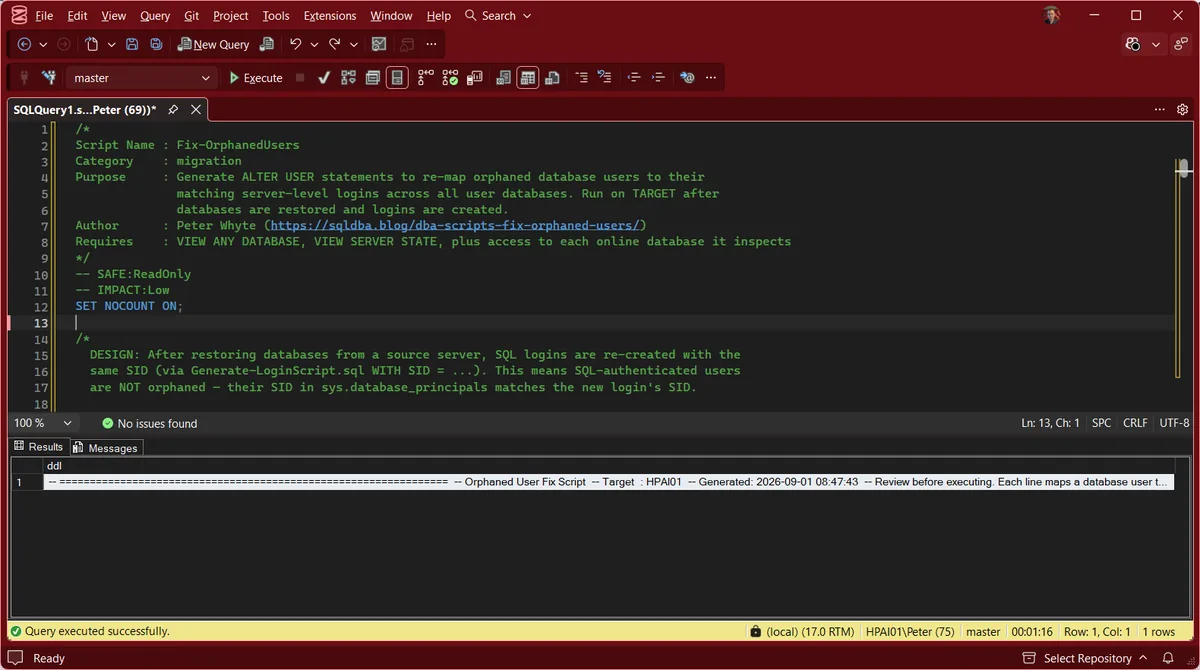
The script returns a single ddl column holding the whole generated script as text. Real output from the lab instance:
-- ================================================================
-- Orphaned User Fix Script
-- Target  : HPAI01
-- Generated: 2026-09-01 00:50:19
-- Review before executing. Each line maps a database user to a login
-- by name - verify the name match is correct first.
-- ================================================================

-- DemoDatabase: 1 orphan(s)

USE [DemoDatabase];
-- Cannot auto-fix: no login named [DemoSeverityUser] found. Create the login first or map manually.
GO
One orphan, and the honest branch: no login named DemoSeverityUser exists on this instance, so the script refuses to guess and says why.
Understanding the Results
The script returns one row and one column, and that single ddl cell holds the entire generated script. In the grid it looks like one long unreadable line, as above. Switch to Results to Text (Ctrl+T) before running it, or click into the cell, and it becomes the script it actually is.
Every line the generated script can contain, and what each one is telling you:
-- DatabaseName: N orphan(s)ALTER USER [x] WITH LOGIN = [x];QUOTENAME, so a name containing a bracket still produces valid SQL.-- Cannot auto-fix: no login named [x] found.-- NOTE: DatabaseName is READ_ONLY.READ_WRITE before the ALTER USER beneath this note can run.-- !! NOT A COMPLETE SCAN-- No orphaned users found.The example above is the same DemoSeverityUser orphan documented on the Get Orphaned Users post, and it lands on the second row of that panel rather than the easy one: the orphan is real, but nothing on this instance is safe to map it to.
Best Practices
- Always review the generated script before running any of it. The name-matching assumption (login name equals user name) is the common case, not a guarantee.
- Treat the output as a script to read, not a result to trust. The generator emits
ALTER USERstatements as text and never runs them, so the review step is the only safety there is. - Run it on the TARGET server after logins have been created, not before. An orphan with no matching login is a signal to go create the login, not a script bug.
- Re-run after creating any missing logins to confirm the remaining output is genuinely empty.
Related Scripts
You may also find these scripts useful:
- Migration Script Generators (pillar)
- Generate Agent Job Script
- Generate Linked Server Script
- Generate Login Script
- Generate Restore with Move Script
- Generate User Mapping Script
- Get Orphaned Users
- Version Upgrade Readiness (Compatibility Level Audit)
- Edition Feature Usage
- Migration Login Audit
- Migration Risk Assessment
- Security (hub), the pillar this sits under
- DBA Scripts: The Complete Guide, the map across every script on this site
- Get Login Migration Parity, compare login attributes between the source and target after the transfer
- CREATE USER WITHOUT LOGIN vs Contained Database Users, why one of them cannot be scripted at all
Frequently Asked Questions
Does running this script change anything?
No. It returns the ALTER USER statements as text and stops. The single EXEC sp_executesql inside it runs the query that collects the orphan list, not a fix, which is why it is classed SAFE:ReadOnly. You copy the output into a new window and run it yourself.
Why does it say “cannot auto-fix” instead of just fixing it?
Because it maps users to logins by name, and where no login of that name exists there is nothing safe to map to. Guessing a different login would hand one person’s permissions to another. Create the missing login and re-run, or map that user by hand.
What about read-only databases?
They are scanned, and their orphans are listed with a note that the database must be set READ_WRITE before the ALTER USER will run. Earlier versions skipped them, which quietly hid real orphans on readable secondaries and archive copies.
Should I use sp_change_users_login instead?
No. Microsoft’s documentation for sp_change_users_login states that the feature “will be removed in a future version of SQL Server” and to “use ALTER USER instead”. That is what this script generates.
Why are some users never reported as orphaned?
Contained database users authenticate inside the database and have no server login to match, so they cannot be orphaned. The script only considers principals whose authentication_type_desc is INSTANCE. Windows users and groups are included; their AD SID does not change, so they orphan only when the login itself is gone.
Summary
Fix-OrphanedUsers turns “you have orphaned users” into a reviewable script, not a chore done user by user across every restored database. It generates the fix where a fix is safe to generate, and says exactly why it can’t where it isn’t, the same honest distinction this post’s own real output demonstrates.
Pair it with Get Orphaned Users for detection and this script for the remediation script, and run both as a standing step after any migration or restore where login SIDs weren’t guaranteed to carry over.
Leave a Reply