
Indexes accumulate the same way clutter does: one developer adds an index to fix a slow query, a colleague adds a near-identical one three months later because the first one wasn’t obvious from the name, and nobody ever goes back to check whether both are pulling their weight. Two indexes on exactly the same columns cost SQL Server twice the write overhead for zero extra query benefit, since the optimizer can only use one of them per query anyway.
This script scans every user database for two specific patterns: exact duplicates (identical key columns) and prefix overlaps (one index’s key columns are a left-prefix of another’s, making the narrower one redundant). It combines the findings with real usage stats so you know which side of each pair is actually being used before you touch anything.
Why Duplicate Indexes Matters
Every non-clustered index has to be maintained on every INSERT, UPDATE, and DELETE that touches its key columns. Two indexes with the same key columns means SQL Server does that maintenance work twice for every write, while queries only ever benefit from one of them.
- Doubles (or triples) write overhead for identical read benefit
- Wastes disk space and buffer pool memory holding a redundant copy of the same data
- Extends backup size and time for no operational gain
- Adds noise to execution plans, making it harder to tell at a glance which index a query is actually using
- A narrower index made redundant by a wider one is doing pure write-cost with no seek advantage the wider index doesn’t already provide
When to Run This Script
- Routine SQL Server health checks
- After a period of ad-hoc index tuning by multiple people or teams
- Before a performance review, to rule out redundant write overhead as a contributing factor
- When auditing a server or database you’ve just inherited
- Alongside Get Heaps and Unused Indexes as part of a general index-hygiene pass
The Script
Run the following script against your SQL Server instance.
- Tested on: SQL Server 2025 (RTM CU8), Windows lab instance
- Last verified: 2026-09-01 (re-run against the lab instance, build 17.0.4075.5)
- Permissions: VIEW ANY DATABASE, VIEW DATABASE STATE
- Safety: read-only, impact low
/*
Script Name : Get-DuplicateIndexes
Category    : performance
Purpose     : Exact duplicate and overlapping (prefix) indexes across all user databases.
              Duplicates waste storage and double/triple write overhead for every DML
              operation. Overlapping indexes (A's key columns are a left-prefix of B's)
              usually mean B makes A redundant. Combines with usage stats to flag duplicates
              that are also unused — the highest priority to remove.
Author      : Peter Whyte (https://sqldba.blog/dba-scripts-get-duplicate-indexes/)
Requires    : VIEW ANY DATABASE, VIEW DATABASE STATE
*/
-- SAFE:ReadOnly
-- IMPACT:Low
SET NOCOUNT ON;
SET QUOTED_IDENTIFIER ON;

CREATE TABLE #idx (
    database_name SYSNAME,
    schema_name SYSNAME,
    table_name SYSNAME,
    index_id INT,
    index_name SYSNAME,
    index_type NVARCHAR(60),
    is_unique BIT,
    is_primary_key BIT,
    is_disabled BIT,
    key_columns NVARCHAR(MAX),
    included_columns NVARCHAR(MAX),
    user_seeks BIGINT,
    user_scans BIGINT,
    user_lookups BIGINT,
    user_updates BIGINT
);

DECLARE @db SYSNAME;
DECLARE @sql NVARCHAR(MAX);

DECLARE db_cursor CURSOR FAST_FORWARD FOR
    SELECT name FROM sys.databases WHERE database_id > 4 AND state = 0;

OPEN db_cursor;
FETCH NEXT FROM db_cursor INTO @db;

WHILE @@FETCH_STATUS = 0
BEGIN
    SET @sql = N'
    INSERT INTO #idx
    SELECT
        N' + QUOTENAME(@db, N'''') + N',
        s.name,
        t.name,
        i.index_id,
        i.name,
        i.type_desc,
        i.is_unique,
        i.is_primary_key,
        i.is_disabled,
        -- Key columns in ordinal order (excluding included columns)
        STUFF((
            SELECT '','' + c2.name
            FROM ' + QUOTENAME(@db) + N'.sys.index_columns ic2
            JOIN ' + QUOTENAME(@db) + N'.sys.columns c2
                ON c2.object_id = ic2.object_id AND c2.column_id = ic2.column_id
            WHERE ic2.object_id = i.object_id
              AND ic2.index_id = i.index_id
              AND ic2.is_included_column = 0
            ORDER BY ic2.key_ordinal
            FOR XML PATH(''''), TYPE
        ).value(''.'', ''NVARCHAR(MAX)''), 1, 1, ''''),
        -- Included columns (order-independent, alphabetical for comparison)
        STUFF((
            SELECT '','' + c3.name
            FROM ' + QUOTENAME(@db) + N'.sys.index_columns ic3
            JOIN ' + QUOTENAME(@db) + N'.sys.columns c3
                ON c3.object_id = ic3.object_id AND c3.column_id = ic3.column_id
            WHERE ic3.object_id = i.object_id
              AND ic3.index_id = i.index_id
              AND ic3.is_included_column = 1
            ORDER BY c3.name
            FOR XML PATH(''''), TYPE
        ).value(''.'', ''NVARCHAR(MAX)''), 1, 1, ''''),
        ISNULL(us.user_seeks, 0),
        ISNULL(us.user_scans, 0),
        ISNULL(us.user_lookups, 0),
        ISNULL(us.user_updates, 0)
    FROM ' + QUOTENAME(@db) + N'.sys.indexes i
    JOIN ' + QUOTENAME(@db) + N'.sys.tables t ON t.object_id = i.object_id
    JOIN ' + QUOTENAME(@db) + N'.sys.schemas s ON s.schema_id = t.schema_id
    LEFT JOIN sys.dm_db_index_usage_stats us
        ON us.database_id = DB_ID(N' + QUOTENAME(@db, N'''') + N')
        AND us.object_id = i.object_id
        AND us.index_id = i.index_id
    WHERE i.type IN (1, 2) -- clustered + nonclustered only
      AND t.is_ms_shipped = 0
      AND i.is_hypothetical = 0;';

    BEGIN TRY EXEC sp_executesql @sql; END TRY
    BEGIN CATCH END CATCH;

    FETCH NEXT FROM db_cursor INTO @db;
END;

CLOSE db_cursor;
DEALLOCATE db_cursor;

-- Exact duplicates: same table, same key columns (order matters), different index
SELECT
    'EXACT_DUPLICATE' AS duplicate_type,
    a.database_name,
    a.schema_name,
    a.table_name,
    a.index_name AS index_a,
    a.index_type AS type_a,
    a.is_unique AS unique_a,
    a.is_primary_key AS pk_a,
    b.index_name AS index_b,
    b.index_type AS type_b,
    b.is_unique AS unique_b,
    b.is_primary_key AS pk_b,
    a.key_columns,
    a.included_columns AS included_a,
    b.included_columns AS included_b,
    a.user_seeks + a.user_scans + a.user_lookups AS reads_a,
    a.user_updates AS writes_a,
    b.user_seeks + b.user_scans + b.user_lookups AS reads_b,
    b.user_updates AS writes_b,
    CASE
        WHEN (a.user_seeks + a.user_scans + a.user_lookups = 0)
         AND (b.user_seeks + b.user_scans + b.user_lookups = 0)
        THEN 'DROP - both unused; keep the one that is a PK/unique constraint if applicable'
        WHEN (b.user_seeks + b.user_scans + b.user_lookups = 0)
         AND b.is_primary_key = 0
        THEN 'DROP index_b - unused duplicate; index_a is being used'
        WHEN (a.user_seeks + a.user_scans + a.user_lookups = 0)
         AND a.is_primary_key = 0
        THEN 'DROP index_a - unused duplicate; index_b is being used'
        ELSE 'REVIEW - both used; keep the one that enforces a constraint; DROP the other'
    END AS recommendation
FROM #idx AS a
JOIN #idx AS b
    ON b.database_name = a.database_name
    AND b.schema_name = a.schema_name
    AND b.table_name = a.table_name
    AND b.index_id > a.index_id
    AND b.key_columns = a.key_columns

UNION ALL

-- Overlapping: index_b's key columns are a left-prefix of index_a's key columns
-- (index_b is made redundant by index_a for seek purposes)
SELECT
    'PREFIX_OVERLAP',
    a.database_name,
    a.schema_name,
    a.table_name,
    a.index_name,
    a.index_type,
    a.is_unique,
    a.is_primary_key,
    b.index_name,
    b.index_type,
    b.is_unique,
    b.is_primary_key,
    'A keys: ' + a.key_columns + ' | B keys: ' + b.key_columns,
    a.included_columns,
    b.included_columns,
    a.user_seeks + a.user_scans + a.user_lookups,
    a.user_updates,
    b.user_seeks + b.user_scans + b.user_lookups,
    b.user_updates,
    CASE
        WHEN b.is_primary_key = 1 OR b.is_unique = 1
        THEN 'KEEP index_b - it enforces a constraint; consider expanding it to cover index_a''s columns'
        WHEN (b.user_seeks + b.user_scans + b.user_lookups = 0)
        THEN 'DROP index_b - unused and made redundant by the wider index_a'
        ELSE 'REVIEW - index_b is used but index_a covers its key columns; consider merging'
    END
FROM #idx AS a
JOIN #idx AS b
    ON b.database_name = a.database_name
    AND b.schema_name = a.schema_name
    AND b.table_name = a.table_name
    AND b.index_id <> a.index_id
    AND b.is_primary_key = 0
    -- B is a prefix of A: A's key list starts with B's key list followed by a comma
    AND a.key_columns LIKE b.key_columns + ',%'

ORDER BY
    database_name, schema_name, table_name, duplicate_type, index_a;

DROP TABLE #idx;
The script builds a temporary catalog of every index’s key and included columns across all online user databases, then self-joins it to find exact key-column matches (EXACT_DUPLICATE) and left-prefix matches (PREFIX_OVERLAP), attaching live usage stats to each side.
How To Run From The Repo
Clone DBA Tools, initialize and run the script:
# Clone dba-tools repo:
git clone https://github.com/peterwhyte-lgtm/dba-tools

# Initialize environment:
cd dba-tools
.\Initialize-Environment.ps1

# Find duplicate and overlapping indexes across all databases:
.\run.ps1 Get-DuplicateIndexes

# To run against a remote sql server:
.\run.ps1 Get-DuplicateIndexes -ServerInstance SQLSERVER01
This script lives in the repo at:
sql/performance/indexes/Get-DuplicateIndexes.sqlpowershell/wrappers/performance/indexes/Get-DuplicateIndexes.ps1
Example Output
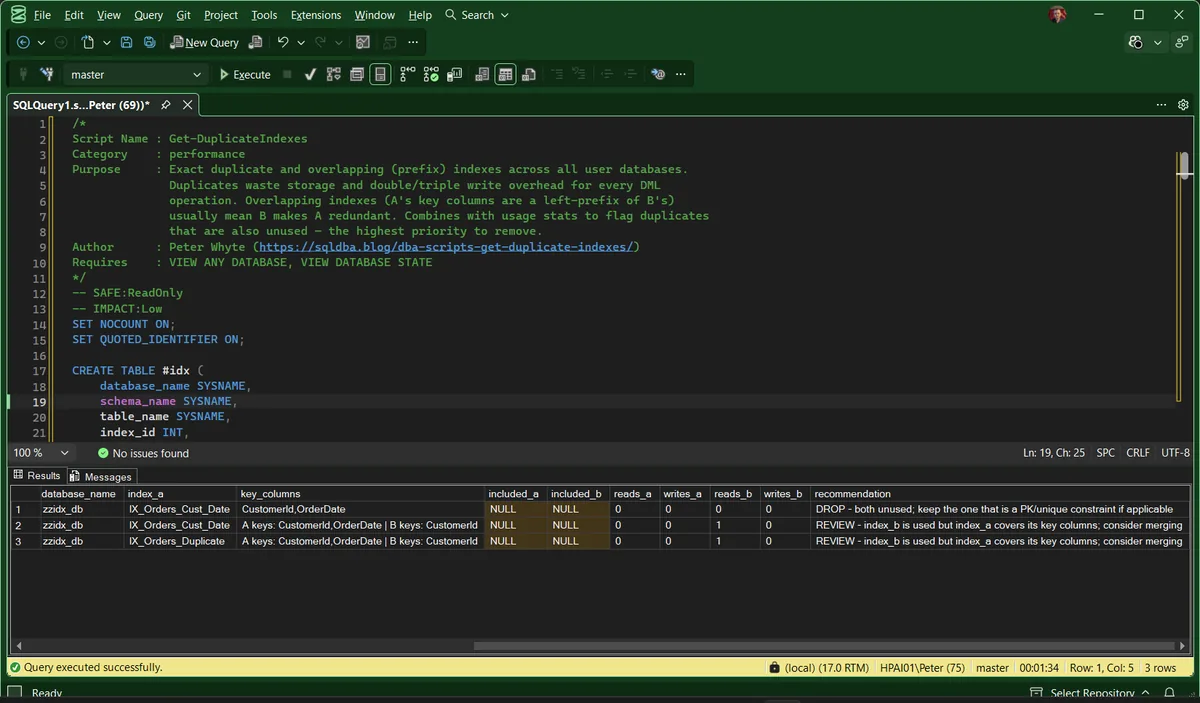
The full result set also includes database/schema names, index types, uniqueness and primary-key flags, and included columns for each side of the pair, but recommendation is the column to act on.
Run against a lab database built with deliberate duplicates, 3 rows come back on the one table. The first is an exact duplicate, and every read and write counter on both sides is zero, so the recommendation is to drop one and keep whichever enforces a constraint.
The second and third are prefix overlaps, where the narrower index’s key columns are a left prefix of the wider one. There reads_b is 1 rather than 0, so the recommendation changes from DROP to REVIEW. Something is using the narrower index, which makes merging the pair a decision rather than a cleanup.
Note that key_columns changes shape between the two. On an exact duplicate it is a plain column list. On a prefix overlap it carries a composed A keys: … | B keys: … string describing both sides of the pair at once, which is easy to misread as a column name.
Understanding the Results
duplicate_typeEXACT_DUPLICATE means the two indexes have identical key columns in the same order. PREFIX_OVERLAP means index_b’s key columns are a left prefix of index_a’s, so index_a can already serve any seek index_b can.database_nameschema_nametable_namedatabase_id > 4 that is in a normal state, so system databases are skipped and an offline database is silently absent.index_aindex_bindex_id. On a prefix overlap index_a is the wider index and index_b is the narrower one it covers.type_atype_bunique_aunique_bpk_apk_bkey_columnsEXACT_DUPLICATE row this is the shared key column list. On a PREFIX_OVERLAP row the same column instead carries a composed sentence in the form A keys: ... | B keys: ..., so read it as text rather than as a column list.included_aincluded_breads_areads_bwrites_awrites_brecommendationHow to Fix Duplicate Indexes
Follow the recommendation column, but don’t drop blind. For each candidate:
- Confirm the index isn’t referenced by a hint (
WITH (INDEX(...))) anywhere in application code. - Check whether either side is
is_uniqueoris_primary_key, since those enforce data integrity and usually need to stay, even unused. - Script the index definition before dropping, so it can be recreated quickly if something was missed.
- Drop the redundant index.
- Re-run this script after a representative workload period to confirm nothing regressed.
-- Drop the redundant duplicate once confirmed safe
DROP INDEX [IX_IndexDemo_CustomerId_Dup] ON [dbo].[IndexDemo];
Best Practices
- Name indexes so their key columns are obvious at a glance. It makes duplicates easier to spot before they’re created, not just after.
- Before adding a new index, check whether an existing one already covers the same or a wider set of key columns.
- Review duplicate and overlapping indexes as a routine part of index maintenance, not just during a one-off performance investigation.
Microsoft’s reference covers sys.columns, sys.databases and sys.indexes in full.
Frequently Asked Questions
Does the optimizer just ignore duplicate indexes automatically?
No. SQL Server maintains every index that exists, regardless of whether another one already covers the same columns. Having a duplicate doesn’t get “optimized away”, it just costs write overhead on every DML operation until it’s dropped.
Is a prefix overlap always safe to drop?
Usually the narrower one is safe once you confirm it isn’t enforcing a unique constraint and isn’t the target of an explicit index hint. If it does enforce uniqueness, keep it and consider whether the wider index should be expanded instead.
Summary
Duplicate and overlapping indexes are one of the easiest wins in index maintenance: no query benefit is lost by removing them, only write overhead. The hard part isn’t the fix, it’s finding them, since nothing in SQL Server proactively flags redundant indexes on its own.
Run this script periodically, especially after periods of ad-hoc index tuning, and treat every EXACT_DUPLICATE with zero reads as a same-day drop.
Related Scripts
You may also find these scripts useful:
- Index Maintenance (hub)
- Heaps
- Index Design Issues
- Index Fragmentation
- Index Fragmentation Across Databases
- Index Usage Stats
- Missing Indexes
- Unused Indexes
- DBA Scripts: The Complete Guide, the map across every script on this site
Leave a Reply